
Guide · Governance, policy and return on investment
AI maturity models: what they are, and how to use one honestly
An AI maturity model is a ladder of stages describing how an organisation’s use of AI typically develops, from no agreed approach to AI built into how the business runs. It helps you see roughly where you are and what the next step is. It is a conversation tool, not a measurement, and published models use different stages.
By Andrew Ward, Founder of ScorchsoftChecked 9 minute read
In short
- A maturity model describes stages; it doesn’t measure you. Use it to agree the next step, not to award yourself a level.
- Published models differ in their stages and in who they are written for. Models written for large enterprises may ask questions a 30-person firm can’t answer.
- Organisations are uneven. Teams, and individuals within them, are often at different stages, and that is normal.
- The AI Stairway™ to Success is Scorchsoft’s own seven-step model (0 to 6). It isn’t an industry standard, it hasn’t been validated, and its step numbers aren’t a benchmark.
- Whatever model you use, place yourself on evidence, pick one next step, and check you are ready for it.
Written for: Owners, managers and governance leads in UK organisations that use AI tools rather than build them.
What is an AI maturity model?
An AI maturity model is a set of ordered stages, each describing what an organisation’s use of AI looks like at that point, so that people can agree where they are and what comes next.
The idea comes from older maturity models used in software and IT, such as the Capability Maturity Model, which describe how practices move from improvised to repeatable, defined and continually improved. Microsoft says its own AI model is based on that one. AI maturity models apply the same shape to AI. Most have two parts:
- Stages or levels, usually five to seven, from early experiments to AI built into how the organisation runs.
- Areas or pillars assessed at each stage, such as strategy, governance, data, technology and people. Some models score each area separately; simpler ones describe the whole organisation in one line per stage.
Also called an AI adoption model, AI adoption stages or an AI capability model. An AI maturity model is related to, but different from, an AI readiness check: maturity describes where you are on a longer path; readiness asks whether the foundations are in place for your next move. Our AI readiness assessment guide has a 12-question self-check for that.
What is an AI maturity model good for, and what is it bad for?
A maturity model is good for starting a shared conversation and choosing a sensible next step. It is bad as a score, a target or a comparison with other organisations, because the stages are descriptions and the placing is a judgement.
| Question | Good for | Bad for |
|---|---|---|
| Where do we stand? | Giving leaders, IT and staff the same words for where things stand | Proving progress to a board with a number |
| What comes next? | Showing that the next step is usually one step, not a leap to the top | Setting a target such as “reach level 4 by March” |
| What is holding us back? | Spotting that one area, such as data or training, is holding the rest back | Comparing yourself with other organisations that placed themselves |
| What should we buy? | Deciding what to fix before you buy or build anything | Choosing a product, because maturity and the tool you use are separate questions |
Two things can make a placing unreliable: describing what you intend rather than what happens, and taking the most enthusiastic team as typical. Placing yourself on evidence, such as which tools are actually in use, guards against both.
Microsoft’s guidance on its own model, checked on 29 October 2026, makes similar points: it says not to use the model “as a one-time assessment or scorecard”, not to collapse it into a single overall score, and to expect maturity to be uneven across areas.
What does a published AI maturity model look like?
Microsoft’s agentic AI adoption maturity model is one free example: five levels across five areas, written mainly for large organisations scaling AI agents. Other models come from consultancies, analysts and software firms, and they differ. Whoever wrote a model, check who it is for and what it leads you to buy.
Microsoft’s agentic AI adoption maturity model (Microsoft Learn, dated 31 March 2026) has five levels, from Level 100, Initial, to Level 500, Efficient, assessed across five pillars: AI strategy and experience, business strategy, AI governance and security, technology and data, and organisation and culture. It is written for organisations scaling AI agents, and it names Microsoft’s own products as examples.
Other models come from consultancies, analysts and software firms, some only for paying clients. Before you adopt one, check who wrote it, who it was written for, and whether its top stage happens to need what its author sells. That test applies to our own model too.
There is no industry standard
As of 29 October 2026, we found no single AI maturity model that is agreed across industry or set by a UK regulator. Each model is its author’s view. Pick one that fits the size of your organisation and stick with it, so that you compare yourself with yourself over time.
What is the AI Stairway™ to Success?
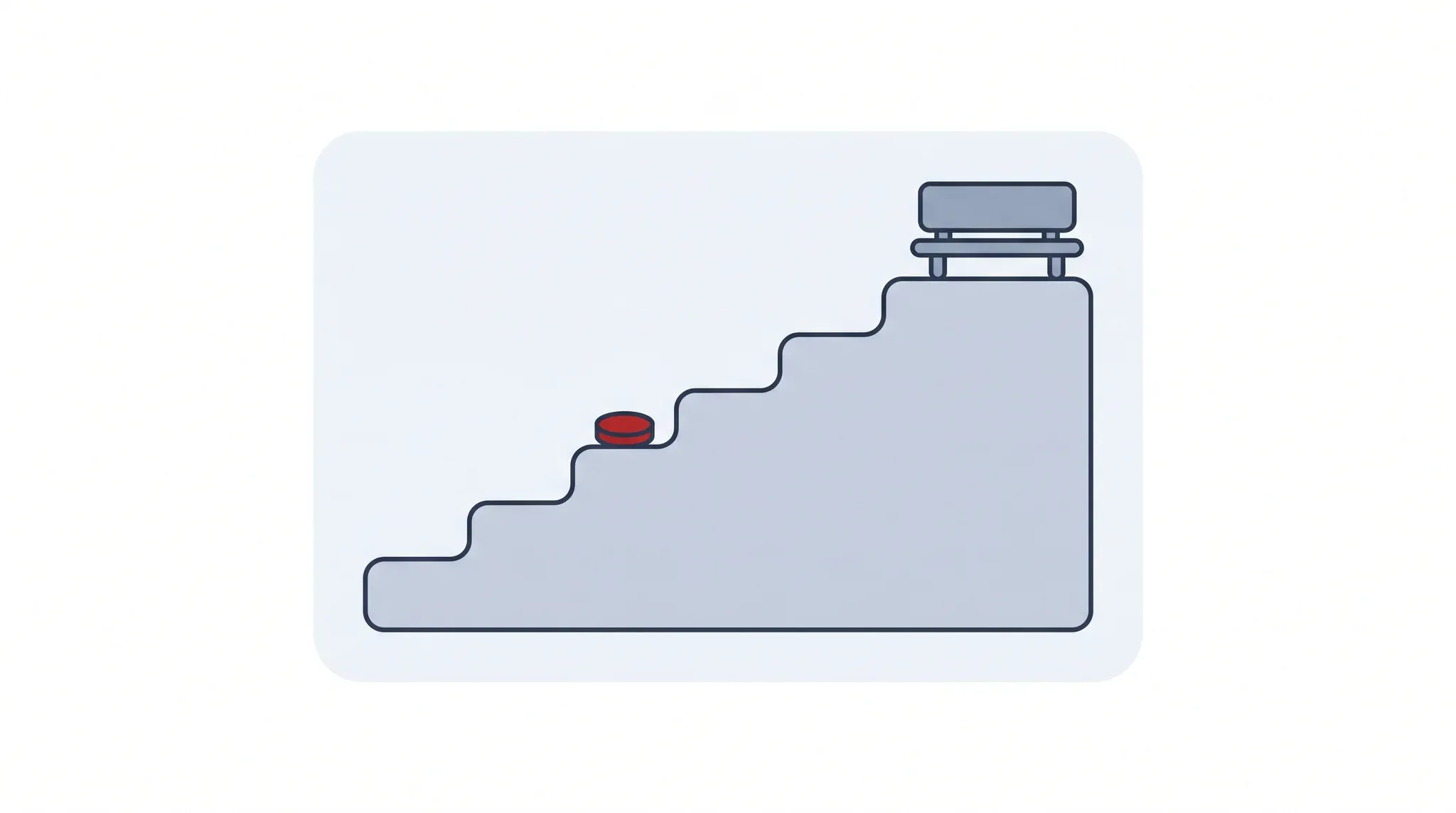
The AI Stairway™ to Success is Scorchsoft’s own seven-step model of how AI becomes part of an organisation that uses it, from step 0, no formal AI adoption, to step 6, AI-first strategy. It is our model, not an industry standard, and it hasn’t been independently validated.
We wrote the AI Stairway™ to Success for organisations that use AI tools rather than build them, so each step describes what you would see in ordinary working life. It describes the whole organisation in one line per step, without separate pillars.
| Step | What it looks like | Where the course covers it |
|---|---|---|
| 0. No formal AI adoption | People may experiment with personal tools, but the business has no agreed approach. | The introductory module and Module 1 |
| 1. Approved AI access | People have suitable business accounts, guidance and tools they’re allowed to use. | Modules 1 and 2 |
| 2. Informal professional use | People use AI for real tasks, learn its limits and find where it helps. Know-how is useful, but personal. | Modules 2 to 6 |
| 3. Shared best practice | Effective instructions, examples and skills are written once and available to the team. | Modules 6 to 8 |
| 4. Reusable agents | A defined task gains its own process, tools, checks and owner. | Modules 8 to 10 |
| 5. Embedded workflows | The process runs as part of normal work, with exceptions and value measured. | Module 10 takes you to the threshold |
| 6. AI-first strategy | Shared systems support several workflows and give people controlled ways to use them. | Beyond the course |
The AI Stairway™ to Success model © 2026 Scorchsoft Ltd. All rights reserved. The AI Stairway™ is a trade mark of Scorchsoft Ltd. Please don’t reproduce or adapt the model without permission.
Three cautions. The step numbers are labels, not a benchmark: step 3 is not a score of 3 out of 6, and we have no data on how many organisations sit on each step. Higher isn’t better for everyone: a small firm may be well served at step 2 or 3. And maturity is separate from the tools you use. As Andrew Ward put it in an article on 7 October 2026, “Adoption maturity and implementation choice are separate”: a well-run purchased workflow can be more mature than an unsupported script.
Can an organisation and its people be at different steps?
Yes, and they usually are. That is why the course asks you to place two markers on the AI Stairway™ to Success: one for your organisation and one for your own practice.
In Module 1, From Unsure to Useful, learners place a marker for where their organisation is and another for where their own use of AI is. The two often differ. Someone may use AI well every day on a personal account (their own practice near step 2) in an organisation that has agreed nothing (step 0). Another may work somewhere with approved tools (step 1) and not have tried them yet. The course returns to both markers as it goes.
Hayley McAllister, a client services coordinator in a 40-person accountancy practice, uses AI daily to draft client chasers, on a personal account, and says nothing. Her practice is around step 2. The practice itself is at step 0: no owner, no approved tool, no rules on data. Gareth Bennett, the practice manager, sees that the next step is the organisation’s, not Hayley’s: step 1, an approved tool and clear rules, so that Hayley’s know-how can come out into the open and be shared.
The gap between the markers is useful. When people are ahead of the organisation, there is usually shadow AI, and the fix is an approved route, not a ban. Our shadow AI guide covers that. When the organisation is ahead of its people, the tools are there but the habits aren’t, and the fix is practical training: see the AI literacy guide.
How do you use an AI maturity model without fooling yourself?
Place yourself on evidence rather than intentions, choose the one next step, check you are ready for it, and look again in six months. Each move has an owner and needs time rather than budget.
Step 1: Place yourself on evidence (AI owner, this week)
For each step, ask what you could show someone: an approved account, a written rule, a shared instruction, a task with an owner and a measure. Place yourself on the highest step where you can show all of it, not the step you are working towards.
Step 2: Ask a few people to place themselves (AI owner, next week)
Ask three or four colleagues in different roles where the organisation is and where their own practice is. Differences between their answers are the most useful thing the exercise produces.
Step 3: Choose one next step and check readiness for it (leadership team, within a month)
Agree the single next step, then run the readiness self-check for it. For the move from step 0 to step 1, that means an owner, one approved tool and tramlines for your data.
Step 4: Look again in six months (AI owner)
Re-place both markers on the same evidence. If nothing moved, ask what got in the way rather than who.
Once you reach the steps where one task gets its own process and owner, test it properly before you scale it. Our 90-day AI pilot guide covers the baseline and the stop rule, the AI ROI guide the arithmetic, and the AI governance guide who decides. Module 10, From Glue to Workflow teaches how to specify a workflow and plan its test.
Questions people ask
Is the AI Stairway™ to Success an industry standard?
No. It is Scorchsoft’s own model, written for organisations that use AI tools. It hasn’t been independently validated, and its step numbers are labels rather than a benchmark.
What AI maturity level should a small business aim for?
The next one that would help, not the top. Many small organisations may be well served by approved tools, clear rules on data and shared good practice (steps 1 to 3 on the AI Stairway™ to Success). Climb further only where a specific task justifies it.
What is the difference between AI maturity and AI readiness?
Maturity describes where you are on a longer path. Readiness asks whether the foundations are in place for your next move. Use a maturity model to choose the next step and a readiness check to see what is missing for it.
How often should we reassess our AI maturity?
Every six months is a sensible rhythm for most organisations, and whenever you are about to widen how AI is used. Use the same model and the same kind of evidence each time.
Can we use the AI Stairway™ to Success in our own materials?
Please ask first. The model is © 2026 Scorchsoft Ltd, and The AI Stairway™ is a trade mark of Scorchsoft Ltd. You are welcome to link to this page.
Training for the whole team
The AI Stairway™ gives everyone the same careful habits, then helps your team agree its rules and test one AI idea properly. Everyone can start with the free introductory module.
AI training for teamsSources
Every figure on this page comes from one of these. Links open in a new tab.
- Introduction to the agentic AI adoption maturity model (opens in a new tab). Microsoft Learn, 31 March 2026.
- How to use the agentic AI adoption maturity model (opens in a new tab). Microsoft Learn, 31 March 2026.
- Why we keep reaching for code when building AI workflows (opens in a new tab). Scorchsoft (Andrew Ward), 7 October 2026.
Keep going
Related guides
- AI readiness assessment: a 12-question self-check for your organisation
- AI governance for small and mid-sized organisations: a simple framework
- AI pilot: how to run a 90-day workplace AI pilot
- AI ROI: how to measure whether AI is paying back
- What is AI literacy? What it looks like at work, and what EU Article 4 asks